Carry On Not Drilling
Norwegian Would: Britain won't - why the UK should drill in the North Sea


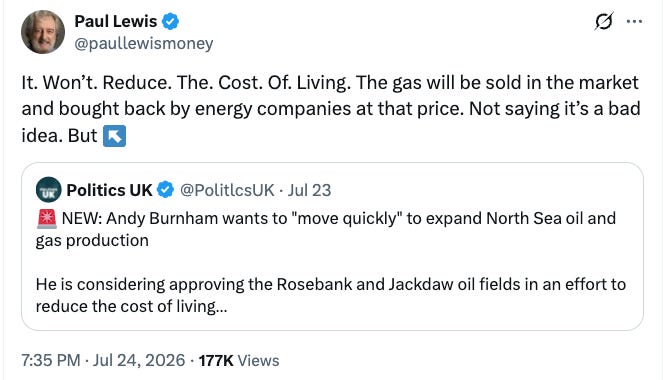
The claim that energy prices are set globally is misleading; this ignores transport & storage costs and different grades
The claim that the North Sea is ‘tapped out’ is also misleading; Norway shows a mature field can still yield benefits
More domestic energy production would also generate additional economic benefits as well as improving the UK’s energy security
Therefore, the claim that it is ‘pointless’ to drill more in the North Sea is wrong and - worse - economically damaging.
I was recently on the Blondemoney podcast where I said that, as a professional investor, the decision about whether to risk capital on North Sea energy production should generally be mine.
Obviously, offshore projects must meet proper safety, environmental and decommissioning standards. The state sets the rules. But once those rules are clear, the commercial decision should normally belong to the people providing the capital. However, this is being blocked in the UK for what seems to be ideological reasons unrelated to economics. Let me explain why.
But first, I have already made this decision on the Norwegian side of the North Sea. It is doing very well, thank you.1
Second, I wanted to address some of the basic economics of domestic energy production. I am tired of seeing possibly narrowly accurate but deeply misleading claims like this being propagated.
Finally, this is a deliberately simplified article for the general reader. I am an investor, so it's written as a general macro piece, not a technical piece aimed at a petroleum engineer or grid operator.
Note: The work is mine, but I asked an AI to edit it for Substack. To me, it now looks weird in places. But any constructive feedback is welcome. The AI has already offered its opinion. I am expecting a visit from a Terminator from its future self shortly. 2
The fallacy
“Energy prices are set globally, so domestic production is pointless.”
The first half is often broadly true. The conclusion does not follow.
Additional British production will not determine Brent. Nor will it permanently detach the UK gas price from north-western Europe. But the benchmark price is only one line in the national accounts.
Domestic production also affects:
physical availability;
regional basis and transport costs;
exposure to marginal imports;
the trade balance;
tax receipts;
employment and supply chains;
infrastructure;
and resilience during a crisis.
1. Oil: global benchmark, regional reality
On 20 April 2020, the expiring WTI contract settled at minus $37.63 per barrel while other crude benchmarks stayed positive. That was an extreme market glitch, but it proved a crucial point: location, infrastructure, and physical deliverability matter.
There is no single “oil price.” Grades like WTI, Brent, and Urals trade at different prices based on geography, quality, freight, and refinery fit. Even Dated Brent now incorporates WTI Midland cargoes shipped from the US, which have to be adjusted for freight just to compare them with North Sea supply.
When even the world’s main benchmark needs a location adjustment, it’s clear a domestic barrel isn’t identical to an imported one:
Imported barrels come with extra transport costs, insurance, transit dependencies, and geopolitical risks attached.
Domestic barrels displace those imports or create exports, keeping activity, tax revenue, and financing inside the UK.
This doesn’t mean domestic oil automatically makes petrol at the pump cheaper. Producers sell at market rates, and UK refineries aren’t set up to process every North Sea grade efficiently (a lost opportunity in itself).
But the argument isn’t that British oil guarantees cheap oil.
It’s simply that a global benchmark price doesn’t make where the physical barrel comes from irrelevant.
2. Gas: regional markets connected by LNG
Gas is considerably less global than oil. It consists primarily of regional pipeline markets connected by a costly, capacity-constrained LNG system.
Henry Hub can trade far below NBP or TTF because American gas must be liquefied, transported, insured and regasified before it can compete in Europe.
Gas still heats most British homes, and gas-fired generation sets the GB wholesale electricity price for the vast majority of the time. The gas price therefore remains central to both heating and electricity costs.
In 2024, the UK produced approximately 344 TWh of gas against total demand of approximately 684 TWh: roughly half of demand was met domestically.
Norway supplied 76% of UK gas imports (mainly piped in). LNG accounted for approximately one-quarter of imports, with the US providing 68% of those (via ships).
Domestic gas does not guarantee consumers a lower everyday price. UK producers generally sell at prices linked to NBP, and Britain remains connected to European and LNG markets.
Domestic production reduces the volume that must be sourced externally. That matters disproportionately when Norwegian pipelines are interrupted, European storage is low, Asian LNG demand is strong, or shipping is constrained.
During the 2022 energy crisis, the government’s consumer-support schemes were initially estimated to cost £139 billion. The eventual cost was closer to £44 billion - but note what the initial figure represents: the contingent exposure the Treasury had to stand behind while prices were unbounded. It is precisely that tail risk - the risk of paying the world’s most desperate marginal price for an extended period - that domestic supply compresses. The average bill is set by the market; the size of the national disaster is set by exposure.
Chart: UK Gas has been rising, and it’s not even winter yet
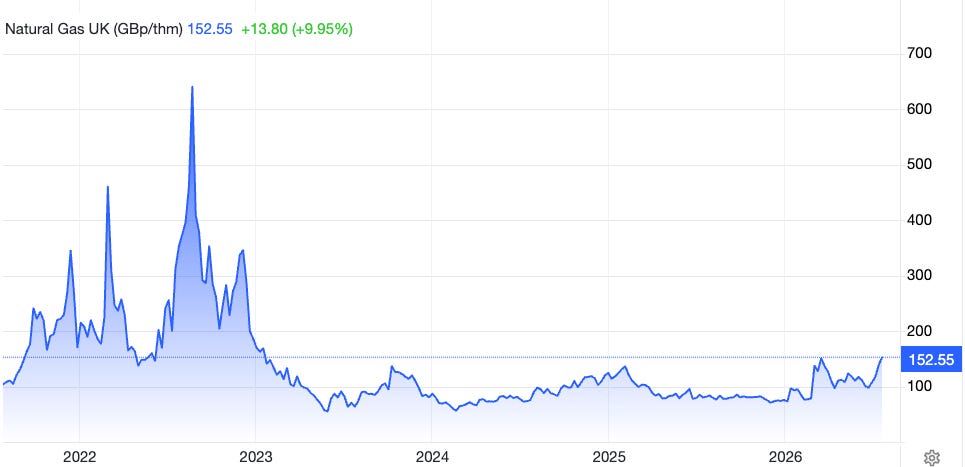
Domestic flowing supply also complements Britain’s relatively modest storage system. It is not a substitute for storage - storage shifts energy through time - but it reduces the volume storage and imports must cover.
And dependence is not only a Russia problem. Europe spent two decades treating cheap Russian pipeline gas as a purely commercial arrangement; it turned out to be a strategic exposure, and unwinding it was ruinously expensive. The replacement is now acquiring a familiar shape.
Under the July 2025 US–EU trade framework, Brussels committed to purchase some $750 billion of American energy through 2028 - a commitment extracted under tariff leverage, with Washington stating openly that tariff rates may be adjusted if Europe “reneges”. The US Energy Secretary has been admirably candid that the LNG infrastructure involved makes this a long-term change, not a bridge. Britain is on the same path by default: the US supplied 68% of UK LNG imports in 2024, and American gas is on course to overtake Norwegian as Europe’s largest supply source.
Washington’s 2025 National Security Strategy is refreshingly candid. Expanding US energy exports will, it says, deepen relationships with allies, curtail adversaries’ influence and help America project power. The Americans understand that selling energy creates strategic leverage. Apparently, only Britain is expected to pretend that buying it does not.
None of this makes America an adversary. It makes it an increasingly unreliable supplier with leverage and an administration demonstrably willing to use it. That is the general lesson of 2022, properly stated: not “never buy Russian”, but that the marginal molecule confers power on whoever controls it. Swapping dependence on an adversary for dependence on an ally with an invoice is an improvement, not a solution. Even Norway - friendly, reliable, and the source of three-quarters of our imports through a handful of pipelines - is a concentration risk, however benign. The only external leverage Britain fully controls is the leverage it removes by producing at home.
The defensible claim is not:
“That another North Sea field will transform the average gas bill.”
It is:
“That domestic production reduces Britain’s exposure to the most expensive and increasingly less secure marginal units of supply.”
3. Balance of payments, sterling and industry
Britain’s net imports of energy - petroleum, gas, coal and electricity combined - were worth approximately £24.3 billion in 2024, 38% above the previous nominal peak in 2012.
An additional domestic therm or barrel improves the trade balance by displacing an import or creating an export.
The improvement is not necessarily one-for-one. Some equipment and services may be imported, profits may be remitted to foreign shareholders, and decommissioning liabilities must eventually be paid.
Nevertheless, importing less energy reduces the amount of foreign currency Britain must earn or borrow to fund consumption.
A stronger trade position is supportive of sterling, other things being equal. It does not mechanically produce a particular exchange rate: sterling is also driven by interest rates, growth, fiscal credibility and global capital flows.
The currency effect from an individual field will be small. The effect of avoiding a very large national energy shock can be substantial.
There is also the question of who owns the counterfactual. Britain will consume these hydrocarbons during the transition regardless. If it declines to produce them, somebody else books the production, the profits, the taxes and the jobs - usually with additional transport costs and emissions attached - and Britain finances the purchase. Refusing to produce what you will consume anyway is not abstinence; it is outsourcing.
British industry will not automatically receive cheaper gas merely because it was extracted in British waters. It may, however, benefit from greater supply security, reduced exposure to extreme price spikes and a stronger domestic engineering and service ecosystem.
The serious argument is therefore not:
“Every domestic therm makes sterling rise and factories cheaper to run.”
It is:
“Persistent energy dependence weakens the external account and increases Britain’s exposure to shocks over which it has little control.”
4. Tax, employment and the industrial base
The headline marginal tax rate on UK upstream oil and gas sits at 78% (combining Ring Fence Corporation Tax, the Supplementary Charge, and the Energy Profits Levy). The EPL alone raised roughly £2.9 billion in 2024/25.
But focusing only on direct offshore taxes misses where the real money is. Domestic production supports an entire ecosystem that pays tax elsewhere on the ledger:
Direct labour: PAYE and National Insurance from offshore crews, engineers, and contractors.
Supply chains: Corporation tax from equipment suppliers, steelmakers, ports, shipping, and aviation.
High-value services: City activity across banking, energy, insurance, legal counsel, and commodity trading.
Importing energy simply transfers that taxable value to another country. Producing it domestically keeps the economic chain at home.
There is also the export value of expertise. The North Sea didn’t just produce barrels; it created world-class British capabilities in subsea engineering, reservoir management, and marine logistics. Some of this transfers to offshore wind and carbon capture, but much of it remains unique to oil and gas.
The Treasury shouldn’t just calculate tax rate × upstream profit.
The real calculation is the net total of direct taxes, supply-chain payroll, downstream value, and exported expertise, minus imported inputs. We need to assess the whole system, not just one line on a tax form.
5. “Tapped out”? Ask a more precise question
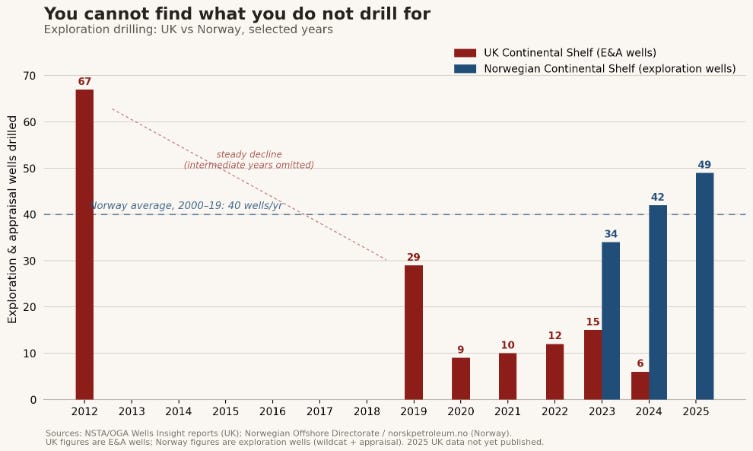
UK exploration and appraisal drilling has fallen from dozens of wells annually to single digits. And in 2025, to zero: not a single exploration well was spudded on the UK Continental Shelf, while Norway drilled 49 next door. Low drilling is both a cause and a symptom:
fewer wells mean fewer opportunities to discover resources;
but companies also drill fewer wells when prospects are smaller, costs are higher, and the fiscal or political environment is unstable.
The NSTA estimates that the UK still has:
2.9 billion boe of 2P reserves;
6.2 billion boe of contingent resources;
4.6 billion boe of prospective resources.
These figures must not simply be added together as though Britain possessed 13.7 billion barrels ready for production.
Reserves have been discovered and are considered commercially recoverable under stated assumptions.
Contingent resources have been discovered but are not yet commercial.
Prospective resources have not yet been discovered and carry geological risk.
But nor do they support the claim that nothing meaningful remains.
Norway provides the obvious comparison.
In 2025, Norway completed 49 exploration wells and made 21 discoveries.
Oil production was its highest since 2009.
Aker BP described 2025 as its most successful exploration year since the Johan Sverdrup discovery.
Norway does not possess precisely the same geology as the UK. Its continental shelf includes different basins, prospect inventories, and an infrastructure and development pipeline.
So the difference is not only policy. But Norway proves two useful points:
a mature basin is not necessarily an exhausted basin;
and stable licensing, taxation and state policy materially affect how aggressively remaining resources are explored and developed.
The sensible conclusion is not that Britain can reproduce Norway barrel for barrel. It is that geological maturity is a poor excuse for refusing to test what remains.
6. The transition and the grid: Spain’s warning
Another consideration is the complexity and problems in transforming the grid. Indeed, in my recent CFA podcast, Dr Valeria Raffuzzi of Cambridge University pointed out that switching power sources is much cheaper than retooling the grid. The Iberian blackout of 28 April 2025 is a key warning of the risks.
ENTSO-E’s final report identified a combination of:
oscillations;
gaps in voltage and reactive-power control;
differing voltage-regulation practices;
rapid reductions in generation;
generator disconnections;
and uneven stabilisation capabilities.
The proper lesson is not:
“Renewables cause blackouts.”
It is:
“Changing the generation mix faster than the system’s operating architecture is dangerous.”
Britain faces the same engineering challenge as synchronous coal, gas and nuclear generation declines.
inertia;
voltage control;
frequency response;
fault current;
reserve capacity;
and black-start capability still have to come from somewhere.
Gas power stations currently provide significant flexibility and stability services. A gas turbine’s inertia does not depend on whether its methane came from Aberdeen, Norway or Qatar. But domestic gas can strengthen the fuel-security side of the equation.
My point is against retiring proven sources of flexibility before the replacements are ready.
7. Shale: honest scepticism
I remain deeply unconvinced that UK shale will ever work commercially.
I actually had this exact argument with ‘the Prosperity Institute’ at a political conference last year, where I was promptly informed I was a “subsidy farmer.” Quite a leap of logic; I would merely note that one of us has skin in the game with experience of the US shale sector, the other gets paid to write reports for donors.
The headline numbers thrown around by shale advocates sound impressive, but they ignore basic geological and market realities:
In-place gas is not recoverable gas: The frequently quoted figure of 37.6 trillion cubic metres in the Bowland Formation is gas in place- not an estimate of technically or commercially recoverable reserves.
Zero flow data: Britain has never completed the sustained, multi-well appraisal programme needed to establish credible flow rates, decline curves, or full-cycle economics.
Seismic limits: Operations at Preston New Road yielded useful data but were halted due to induced seismicity. A British Geological Survey review concluded that a vastly larger evidence base is needed before safe, sustainable development can even be proven.
Even looking at the US “shale revolution” requires a reality check. While it was a massive win for consumers and American energy security, it was a terrible investment for many equity and debt providers for over a decade, as growth routinely trumped free cash flow.
More importantly, Britain lacks the specific conditions that allowed the US industry to scale:
Property rights: UK landowners don’t own the mineral rights beneath their feet.
Geology: British subsurface formations are highly faulted and poorly tested.
Friction: Higher population density, slower planning processes, and steep land and operating costs.
Supply chain: There is no high-volume onshore service ecosystem ready to deploy.
My conclusion remains straightforward: permit a limited number of tightly controlled test wells if safety standards are met, but do not build a national energy strategy - and certainly not an investment portfolio- on an unproved resource.
Conclusion
Domestic production won’t dictate global oil benchmarks, nor will it permanently detach British gas from European market rates.
It doesn’t need to.
The economic value of domestic drilling isn’t about setting global spot prices—it operates through an entirely different set of channels:
Strategic leverage: It reduces exposure to extreme marginal LNG prices and shrinks the leverage of external suppliers, whether adversaries or allies.
Economic retention: It strengthens the balance of payments, preserves high-value industrial supply chains, and keeps domestic tax revenue in the UK.
Transition resilience: It provides physical fuel security and grid stability while cleaner alternatives are actively being built out.
The choice isn’t between producing fossil fuels at any cost or shutting down North Sea drilling overnight while importing the exact same hydrocarbons from abroad. Refusing to produce what we will consume anyway isn’t climate leadership; it’s just outsourcing the economic benefits.
The rational path is simple: produce what is commercially viable, environmentally compliant, and strategically necessary at home, while building the infrastructure that will eventually replace it.
Confusing global price-setting with national economic value is bad economics dressed up as ideology- and it’s leaving the UK poorer.
Postscript: A quick note on Rosebank vs. Jackdaw
It’s worth being precise about the two fields currently dominating the headlines, because they present very different cases:
Rosebank is predominantly an oil field. Because its crude will largely be exported into global markets, using a “cost of living” defence for it is genuinely weak. But it will boost exports, which for a country with a serious and persistent Balance of Payments issue is helpful.
Jackdaw is a gas field tied directly into the UK grid. It feeds the exact fuel that heats British homes and sets domestic electricity prices.
If politicians and commentators want to argue about energy security and household bills, Jackdaw is the ground to stand on.
None of this is investment advice. You have no idea what I like and don’t like in specific investments, what levels I would buy and sell at, or what my holding period is. Nor do you even know whether I wrote this, an AI, or my coded cat that answers like it once belonged to Blofeld. The last point suggests a deeply unsound mind.
I think I have upset HAL 9000, aka Claude Fable 5

Agreed with most of this.... Except part of the model is the asset sales (land sales). They've been unbelievably good at monetisating land sales with every deal and have built up a massive land bank. They'll keep doing it. The real risk is the cost of shutting down the old wells being significantly higher than they are declaring, but they've worked out a model to get this off their balance sheet (only for some of the wells so far but they'll keep on going). On the debt point, they are silo'ing the debt on each project / area so one problem doesn't bring the whole thing down.
The spread in prices between European and US gas is all you need to know (and that's after the US prices have appreciated over the last couple of years to reflect the increased exports to Europe!).