The Putz
'America First' have some valid points. But the US's current approach to statecraft is an perfect anti-Machiavellian example of how not to do it.

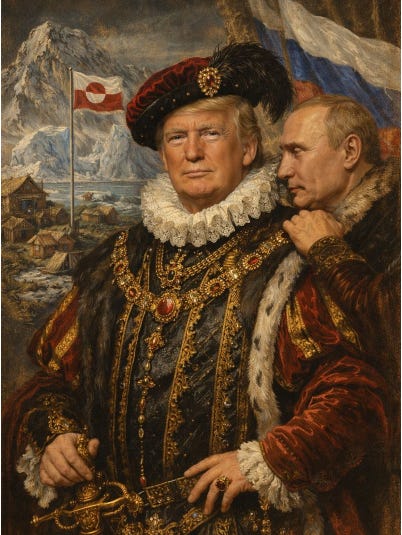
If Trump wanted expert advice on how to destroy power and accelerate decline, there is no better person to listen to than Putin.
The heretics have a point. Mark Carney’s recent Davos speech implicitly conceded that the “America First” proponents have a valid point; hyper-globalisation hollowed out the Western middle class, validating Sir James Goldsmith’s decades-old warnings.
But a diagnosis is not the cure. Trump’s brand of “transactional” foreign policy is likely to end up being “imperial self-harm”. History shows that abandoning alliances for brute force breeds resentment and accelerates decline.
Investment Pivot: As countries shift strategies from “optimisation” to “resilience,” investors should favour hard assets and immediate cashflows over long-duration “paper promises.”
At Davos last week, Canadian Prime Minister Mark Carney said the quiet part out loud.
The “rules-based order” isn’t wobbling—it’s ending. Not a transition, a rupture. For investors, the question isn’t whether the world is changing. It’s whether the new American posture - muscular, transactional, and proudly self-interested - is the new Realpolitik of realism with steel-toed boots, or imperial self-harm dressed up as toughness.
The Diagnosis Was (Mostly) Correct
First, let’s grant the heresy: the proponents of “America First” aren’t wrong that the last 30 years of hyper-globalisation produced distortions. Even Carney - a consummate Davos dweller - acknowledged some of this.
Just as Sir James Goldsmith warned, over 30 years ago, on US prime-time television, that “free trade” between countries with radically different labour costs wouldn’t lift all boats. It would hollow out the Western middle class and turn politics toxic. He was mocked. He was just early.1
Michael Pettis has been even more explicit—especially in Trade Wars Are Class Wars: persistent global imbalances aren’t random. They are engineered. Surplus countries suppress consumption (through wages, credit structures, and institutional design) to subsidise exports. Someone has to absorb that excess production. For several decades, the United States played the role of the “consumer of last resort,” importing goods and exporting its industrial base. This has led to exactly the outcomes that Goldsmith has predicted.
So yes: tariffs, industrial policy, and a tougher stance toward asymmetry are not irrational. They are a response to a system that often rewarded mercantilism and punished openness.
But a correct diagnosis doesn’t guarantee the proposed cure won’t make things worse.
The Machiavellian Trap
The cure, apparently, is to run foreign policy like a mob enforcer. Well, Trump did learn his trade in New York, so perhaps it’s not hugely surprising.
Machiavelli2 is often quoted by people who want the license but not the warning label. Yes: better to be feared than loved. But many appear to have forgotten that he adds the line that matters: avoid being hated.
Fear can stabilise. Hatred coordinates.
When you treat allies as vassals to be shaken down - rather than partners in an architecture - you don’t just generate resentment. You generate incentives for quiet resistance: hedging, foot-dragging, and eventually coalition-building against you.
Empires don’t usually fail in a single battle. They fail when their networks stop cooperating.
Imperial Overstretch Has Entered the Chat
Paul Kennedy’s The Rise and Fall of the Great Powers gives us the structural problem: “imperial overstretch.” Commitments expand faster than economic capacity. The maths doesn’t care about slogans. As I articulated in this investor presentation, America has exactly this problem.
Here’s the problem: influence is cheap; force is expensive.
When the US led through legitimacy and alliances - NATO, multilateral institutions, predictable rules—it could share burdens and outsource some of that enforcement. A purely transactional posture changes the model. Every relationship becomes a stress test or a battle of wills. Every agreement becomes provisional. And if everything is provisional, you must enforce everything yourself.
That’s not statecraft. That’s a cost centre.
And it lands on a balance sheet already weighed down by debt, political fractures, and institutional fatigue.
The Entropy of Empire
My good friend David Murrin’s book Breaking the Code of History lays out the “Five Stages of Empire.” The pattern is familiar: late-stage systems grow defensive, retrospective, and punitive. Protectionism and force-first diplomacy aren’t always “strategy.” Sometimes they’re reflex.
Will Durant, in Lessons of History, reminds us that civilisations usually die from within. Polarisation, debt, distrust, loss of shared purpose—these are internal corrosion problems. External aggression often masks them. It rarely fixes them.
The Cultural X-Factor: Institutions
David Landes, The Wealth and Poverty of Nations, points to the boring superpower: institutions. Rule of law. Contract predictability. Stable governance. The things that make capital comfortable.
If America shifts from “rules” to “mood”—treaties as optional, tariffs as executive improvisation, deals as temporary theatre—it doesn’t end the dollar’s role overnight. Reserve status is sticky. But trust bleeds at the margin. And marginal repricing is how risk premia rise.
You can be powerful and predictable and get cheap capital. You can be powerful and erratic and pay for it.
Phase Transition: Where Systems Get Weird
The problem is, where are we now? In complex systems, such as the global economy, a crucial moment is a phase transition. Water becomes steam: same molecules, different physics.
We are plausibly leaving the Great Moderation - cheap energy, frictionless trade, central banks with a technocratic halo - and entering an era of constraint: geopolitics, demographics, debt arithmetic, and institutional stress. Whilst this might be the underlying path, there is likely to be significant ‘noise’ and investment volatility masking the underlying changes.
This is also where “fiscal dominance” becomes a risk. The Fed may face increasing pressure (explicit or implicit) to keep financing conditions from breaking government solvency and market plumbing. That doesn’t guarantee inflationary collapse. It does mean the reaction function gets less “pure.” The currency’s purchasing power becomes one of the release valves.
Counterintuitively, other countries may crack earlier and harder than the US. Rome didn’t burn in a day, as my father used to say. The periphery usually goes first.
And supply chains? The shift from Guangdong to “somewhere else” is not a toggle switch. Trust is slow to rebuild, and it remains very unclear that a Vietnam or India would be any sort of longer-term improvement. Resilience is not free.
Investment Implications (No, This Isn’t a Tip Sheet)
Short term: The muscular approach can produce tactical wins. Some domestic production gets a policy tailwind. Some sectors benefit from reshoring and strategic procurement. The dollar can strengthen episodically - especially when the alternative jurisdictions look worse.
But don’t turn that into a law of nature. Tariffs come with a multitude of their own problems. Retaliation exists. And “strong dollar” is not guaranteed when policy uncertainty is the export. It is likely to insert an uncertainty premium into US Treasuries at some point.
Long term: the more durable point is regime: fragmentation raises volatility and makes optimisation brittle. We’re replacing “efficient and cheap” with “redundant and expensive.” Not ideology - re-engineering global logistics.
And the global re-engineering costs show up somewhere: margins, prices, fiscal deficits, required returns.3
I’ll write more on this at a later date. But the short version: the market has priced energy for a smooth transition that isn’t happening, in a geopolitical environment that no longer exists. 4
Closing
The last thirty years rewarded optimisation. The next decade is likely to reward resilience.
So we tilt accordingly: away from pure “paper promises” that require perfect conditions, and toward things that survive imperfect ones.
Paper is fine—until it’s a claim on someone else’s competence.
Sir James Goldsmith - the Anglo-French financier who had correctly called both the 1987 crash and the OPEC price spike- testified before the US Senate in 1994 that GATT would hollow out Western middle classes while enriching multinationals. His books, The Trap and, even more insightfully, The Response, argued that we had inverted values: making economic indices the goal rather than human welfare the measure. Despite being a self-made billionaire in a time that was rare, he was dismissed as a protectionist crank by the economystics of the dismal science. He was describing the next thirty years.
The Prince gets the headlines. But Machiavelli’s longer, deeper work—the Discourses on Livy—is where he dissects republics. It reads, uncomfortably, like a diagnostic manual for contemporary America.
Rome’s dilemma was structural. To remain stable like Sparta or Venice, it would have needed either to keep its commons unarmed or to close its borders. Rome did neither—it armed its citizens and welcomed immigrants. This made it powerful but unstable. Paradoxically, the forces that drove Roman greatness were the same tumults that eventually destroyed the Republic.
Machiavelli is explicit about corruption. A wicked citizen, he writes, “cannot work for ill in a republic that is not corrupt.” The causation runs backwards from what we’d like to believe. Bad leaders don’t corrupt good systems. Corrupted peoples select for bad leaders. And the root cause? “Such corruption and so little aptitude for living in freedom arise from an inequality that exists in the city.”
Armed citizens. Mass immigration. Yawning inequality. A ruling class that treats public office as private equity. A populace that can no longer distinguish between leadership and its pantomime. Machiavelli wouldn’t need to update a word.
The only question he’d ask is whether America is on the upslope or the downslope—and whether anyone in charge can tell the difference.
Oddly, the UK market starts to look… not terrible.
If the thesis is "short duration beats long duration," UK equities deserve a mention. The FTSE 100 trades at roughly half the multiple of the S&P 500, yields three times as much, and is dominated by energy, pharma, defence, and financials—sectors that generate cash today rather than promising growth tomorrow. In a regime where discount rates matter and the future is contested, duration matters. The UK market is short-duration by construction: Shell dividends, AstraZeneca cash flows, money in hand. This doesn't make it a table-pounding buy—structural problems remain—but the asymmetry between "priced for terminal decline" and "actually generating cash" is worth noting. More detailed analysis to follow.
Here’s something that doesn’t fit the current narrative: energy looks really, really cheap.
The last decade taught investors to treat hydrocarbons as a melting ice cube—stranded assets in waiting, best avoided by anyone with ESG paperwork to file. Capital fled. Exploration budgets collapsed. The supermajors pivoted to share buybacks and transition PR.
Meanwhile, the world still runs on oil and gas. The energy intensity of AI datacentres alone is rewriting demand curves. Reshoring and “redundant and expensive” supply chains need power. Electrification needs grid capacity that doesn’t exist. And the transition darlings—wind, solar, batteries—depend on mining and processing supply chains that run through countries we’re now supposed to be decoupling from.
In a regime of fragmentation and constraint, energy isn’t a legacy sector. It’s the foundation asset. Everything downstream—manufacturing, logistics, computation, agriculture - depends on molecules and electrons showing up reliably.
European majors trade at single-digit multiples with dividend yields of 5-7%. The market prices these as terminally declining businesses. If the “Great Moderation” is over and we’re entering an era of constraint and strategic competition, that pricing looks backwards.